How Does a High-Speed Fully Automatic Production Line for Liquid Filling, Capping, and Packing of Glass Bottles and Vials Work?

In the modern manufacturing landscape, the need for efficiency, precision, and sterility is more critical than ever-especially in the pharmaceutical, cosmetic, and food and beverage industries. When these industries require the mass production of liquid products in glass bottles or vials, a high-speed fully automatic production line becomes a cornerstone of their operations.
🔍 1. Understanding the Full Process of a High-Speed Automatic Filling Line
A high-speed fully automatic production line for liquid filling, capping, and packing of glass bottles and vials is a highly integrated, precision-controlled system that ensures consistent product quality, increased throughput, and reduced labor costs.
Each step is designed to work seamlessly with the next, under high-speed automation and strict industry standards (such as GMP and ISO), ensuring safety, efficiency, and accuracy throughout the production process.
💡 2. How Do High-Speed Automatic Filling Machines Handle Glass Vials and Bottles?
Glass bottles and vials come in various shapes, sizes, and material thicknesses, and high-speed automatic filling systems are engineered to accommodate multiple container types without compromising speed or accuracy.
Bottle Handling Systems: High-speed platforms use vibrating conveyors, star wheels, or mechanical arms to ensure precise and gentle handling of bottles.
Adaptability: Systems are often modular and can be customized to fit different container sizes, filling volumes, and viscosity levels of the product.
Sterile and Clean Environments: Especially in the pharmaceutical industry, these lines operate within ISO Class 5 (Grade A) zones to maintain aesthetic and microbial purity.
Whether you're working with vials for injectable drugs or glass bottles for cosmetic creams, the design of these machines ensures seamless insertion, tight sealing, and minimal contamination risk.
⚙️ 3. What Are the Key Components of a Fully Automated Filling and Packaging System?

These systems are complex, with each component playing a vital role in the overall efficiency and quality of the process. Here are the essential parts:
Responsible for transporting sterilized and cleaned bottles from storage to the filling zone. Advanced systems use vibrating trays, star wheels, and hopper feeders to ensure consistent and organized flow.
This is where fluid delivery occurs. Machines use peristaltic pumps, weight-based fillers, or volume-based fillers to deliver the exact amount of liquid required.
Precision: Typical filling accuracy ranges from ±0.5% for volume-based systems and ±0.1% for weight-based systems, ensuring consistency and waste reduction.
FS&S Technology: The "Fill Start & Stop" feature enables the system to stop filling if a bottle is missing, preventing overfilling or underfilling.
Once filled, the vials or bottles move to the capping and sealing station, where they are automatically sealed using plastic stoppers, rubber bungs, or aluminum seals.
Sterility Requirements: In Grade A cleanrooms, this process is conducted with laminar airflow, clean-in-place (CIP) systems, and seal integrity tests.
After sealing, the bottles are often labeled with QR codes, batch numbers, or expiry dates. This step is crucial for traceability, product identification, and regulatory compliance.
Synchronized Labeling: The labeling system ensures accurate placement without tilting or misalignment.
Here, the filled and labeled bottles are boxed, cartoned, and stacked using automated packers, box folders, and conveyor systems.
Packaging Accuracy: These machines ensure proper stacking, tight sealing of boxes, and correct weight and count for each package.
Unlike basic lines, modern systems incorporate real-time quality control mechanisms, such as:
Visual Inspection Systems: Check for defects, air bubbles, and proper fill levels.
Weight Verification Systems: Ensure each bottle has the correct volume.
Automated Rejection: Bottles that fail inspection are segregated and rejected automatically, without manual intervention.
💧 4. How Is Liquid Filling Achieved with Precision in a High-Speed Line?

One of the most important aspects of a high-speed automatic filling line is precision. Any deviation in the amount of liquid dispensed can affect product quality, regulatory compliance, and safety.
Peristaltic Pumps: These are highly precise and minimize product contact, ideal for sterile filling.
Weight Sensors and Load Cells: Used for weight-based filling, especially with prescription drugs and cosmetics.
Vision Systems: These are used to detect fill levels, label accuracy, and container integrity.
For example, when filling a 10ml antibiotic vial, the system will:
Position the vial accurately.
Deliver exactly 10.2ml (to account for any loss during stopper placement).
Complete the fill in under 1 second, maintaining ±0.5% accuracy.
Ensure that the stopper is seated correctly, without distortion.
This level of precision is especially vital in the pharmaceutical industry, where consistency and safety are non-negotiable.
🧼 5. The Capping and Sealing Process: A Critical Step in Automation
Capping and sealing are not just maintenance steps-they're critical to product integrity, long shelf life, and safety. In industries like pharmaceuticals and cosmetics, hermetic sealing is essential to prevent contamination.
Rotary Capping: Slides bottles under a capping head and inserts the stopper automatically.
Vacuum Capping: Ensures the stopper is fully seated under controlled pressure, minimizing air pockets inside the vial.
Tight Sealing: Machines often use high-strength seals and pressure testing to ensure container closure integrity is maintained.
These tests are especially important in GMP-compliant environments, where mixed contamination or seal failure can compromise the safety and efficacy of the final product.
🖨️ 6. What Techniques Are Used for Labeling and Final Packaging?

Labeling and packaging are final steps that ensure your product is ready for distribution, use, and compliance.
Synchronized Application: Labels are applied using rotary labelers that rotate the bottle while applying the label.
Coding Systems: These can include direct thermal printing, inkjet printing, or laser marking to apply batch numbers, expiry dates, and lot codes.
Custom Labeling: Options for different label sizes, colors, and materials are often available to suit various product requirements.
Box Folding Machines: Fold cartons automatically.
Palletizers and Stackers: Organize products into pallets or stacks for easy logistics handling.
Multi-Layer Packaging or Blister Packs: Used for high-value or environment-sensitive products.
These systems often provide real-time visibility, enabling smooth batch tracking and logistics coordination.
🔬 7. Quality Control and Testing in the Automated Production Line
Ensuring product quality and consistency is the ultimate goal of any automated filling and packaging line. This is why the system includes advanced quality control measures at every stage.
✅ In-Process Inspections
Every 100th bottle may be weighed to check for fill accuracy.
High-Resolution Cameramakers perform micro-defect analysis, detecting hairs, particles, and label misalignment.
Visual and X-ray Inspection Systems are used to ensure container and product integrity.
Seal Integrity Test: Ensures no leakage and seal strength.
Dimensional Inspection: Verifies bottle shape, stopper position, and product consistency.
Only qualified products are sent to the final sorting and packing stage.
💥 8. Technical Innovations That Drive High-Speed Automation in Filling and Packaging
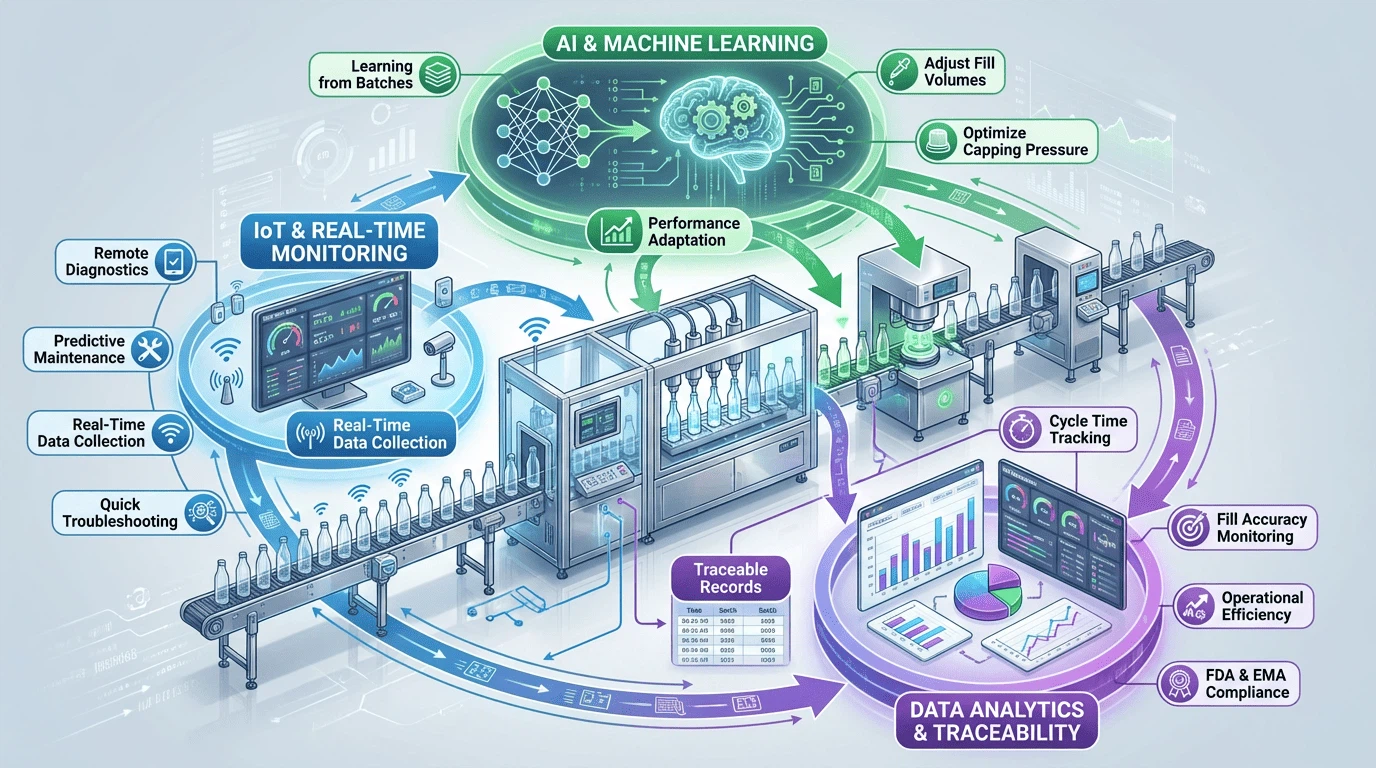
The rise of smart manufacturing has brought innovative technologies to the forefront of high-speed automated production. Some of the most impactful innovations include:
These systems can learn from past batches and adjust fill volumes and capping pressures for better performance.
AI-powered defect detection reduces false rejections and improves production efficiency.
IoT and Real-Time Monitoring
IoT-enabled machines allow for remote diagnostics, real-time data collection, and predictive maintenance.
This ensures consistent operation and quick troubleshooting.
Modern systems track key performance indicators (KPIs), such as cycle time, fill accuracy, and operational efficiency.
They also provide traceable manufacturing records, ensuring compliance with regulations like FDA and EMA.
These technologies not only enhance efficiency but also ensure product traceability and automated quality assurance.
🚫 9. Common Challenges and Solutions in High-Speed Glass Vial Filling and Packaging
While high-speed automation is a game-changer, it's not without its challenges. Here are some of the most common issues and how they're overcome:
| Implement automated recalibration protocols and real-time data monitoring | |
| Maintain ISO 5 (Grade A) cleanrooms and laminar airflow systems | |
| Use high-resolution vision systems to detect label placement and adjust automatically | |
| Utilize GMP-compliant weighing and volume control systems for accurate dosing |
By addressing these issues with advanced automation and quality control, you can significantly reduce downtime, product defects, and costs.
🧑🔬 10. Industry Applications: From Pharmaceuticals to Cosmetics
These high-speed fully automatic lines are versatile and applicable across multiple industries:
Injectable drugs, vaccines, and powdered medications rely on sterile filling and sealing.
High standards of hygiene and consistency are crucial in this sector.
Serums, lotions, and perfumes are often packed using these systems.
Slim container designs and small-batch production are supported with modular setup.
Juice, soda, and alcohol bottles are filled and sealed at high speeds.
Food-safe materials and hygienic handling are vital.
Small vials for lab use are packed using high-precision filling systems.
These systems ensure sample integrity, batch tracking, and secure sealing.
Each of these industries benefits from the speed, reliability, and precision offered by high-speed automation.
11. Guangzhou Rito Packaging Machinery: A Trusted Partner in Automation

With over 10 years of experience in packaging solution development, Guangzhou Rito Packaging Machinery Co., Ltd. has become a leading manufacturer of high-speed automatic filling and packaging systems for glass bottles and vials.
10+ Patents: Including invention patents, ensuring cutting-edge design and technological leadership.
: Tailored for all industries-from pharmaceuticals to cosmetics.
: From equipment design, on-site installation, to full automation training.
: With branches and agency centers in over 40 countries and regions, including China, the United States, Germany, and beyond.
: Our systems are built with GMP, ISO, and FDA compliance in mind, ensuring safe and reliable operations.
Quick Response and After-Sales Support: We offer lifetime maintenance, software upgrades, and 24/7 technical assistance.
Whether you're looking to scale your production, reduce labor costs, or ensure product quality and safety, Guangzhou Rito has efficient, reliable, and high-performance systems to meet your needs.
📈 12. The Future of Automated Liquid Filling and Packaging
More AI integration for smart decision-making.
Improved energy efficiency through integrated CIP and recycling systems.
Higher flexibility with rapid changeovers and multi-product compatibility.
Remote monitoring and control via IoT platforms.
These innovations are driving the future of packaging automation, making it more efficient, safer, and sustainable.
A high-speed fully automatic production line for liquid filling, capping, and packing of glass bottles and vials is the cornerstone of modern manufacturing, especially in pharmaceutical and cosmetic industries.
From bottle infeed to final packaging, these systems are engineered for precision, speed, and sterility. They reduce errors, increase production efficiency, and ensure compliance with GMP, ISO, and FDA standards.
If you're looking for reliable, high-performance, and compliant filling solutions, Guangzhou Rito Packaging Machinery Co., Ltd. stands ready to support your automation journey with innovative, customizable, and fully automated systems.